
Musical Lineages
Lately, I’ve been thinking about lineage: what we inherit, how we become aware of these inheritances, and how we respond to these inheritances. Do we carry them forward, rebel against them, or take them in new directions? I touched on this in my last blog post about listening to new music, but these questions were prompted after a recent conversation with our marketing team. They asked about Teddy’s connection to Leonard Bernstein and why it matters that Teddy considers Bernstein his "grand-teacher" (Bernstein taught Michael Tilson Thomas, who taught Teddy). Lineage and its inheritances may have a particular relevance to the arts—or at least to music—because the educational model remains an apprenticeship: the most intensive training comes through one-on-one work with a teacher over many years. For most, this starts in elementary school and continues through graduate study. Our teachers shape our artistic identities—a lot of established artists still hear their teachers’ voices in their heads decades later!
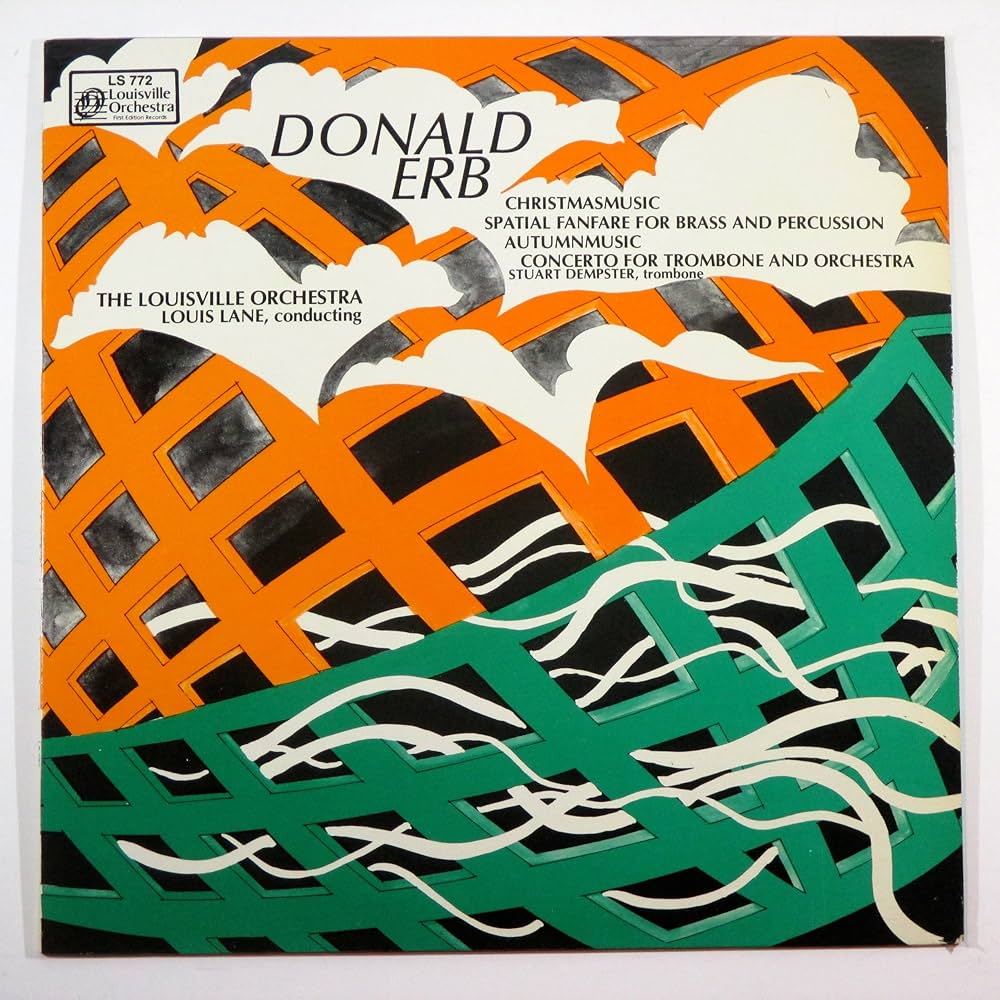
My supervisor, Sarah, has a series of framed LO First Edition records hanging on her office wall, and each time I enter, I’m greeted by my own grand-teacher, Donald Erb. Erb’s LP was released in 1980 and features three of his works: his Trombone Concerto (performed by legendary experimental trombonist Stuart Dempster), Christmasmusic, and Autumnmusic. Erb was one of the most influential American composers and teachers of his generation, and his music was widespread in the 70s-90s. It’s rarely performed these days, which is a shame, because the three pieces on that album are absolutely thrilling in their complexity, richness, and sonic invention.
I never got to meet Erb, who died in 2008, but two of my most important composition teachers, James Mobberley and David Felder, studied with him at the Cleveland Institute of Music. They both told me stories about Erb’s generosity, but also his rigor and high standards of excellence. They said he did not suffer fools gladly, and inspired deep thoughtfulness and a fearless, pioneering spirit in his students. These teachings and outlooks certainly left a mark on Mobberley and Felder, both of whom passed along those attitudes to their students, including me. When I hear Erb’s work, I feel connected to a kindred spirit; not only because I hear his influence in the music of my teachers (it’s certainly there), but I like to think that somehow, subconsciously, I chose Erb’s students to be my teachers because of some kind of ancestral force, a cosmic musical affinity that attracted me to people who think about music in the same way I do.
Erb’s LP also reminds me of the lineage I participate in with my work at the LO. We at the LO often describe the Creators Corps as radical and forward-thinking, but out of all of the current programs at the LO, the Creators Corps most deeply resonates with the orchestra’s founding ethos of putting living composers at the forefront - allowing them to interpret and respond to the world their own audiences experience. Teddy often places the LOCC in the context of the LO’s history, connecting the First Edition mindset to 21st-century ears. While the First Edition days were before my time, I experienced their traces as a teenager through the LO’s "New Dimensions" series. Hearing new works by living composers at those concerts defined for me what music could be and what an orchestra should be, and set me on the path that ultimately led me back to the LO itself. I didn’t really connect with the “classics” as a child - maybe Beethoven, Brahms, and Mozart reminded me too much of the piano lessons my mom forced me to take - but hearing living composers do unprecedented things with sound and ask probing questions about what music can do made my world feel vast with possibility.
We tend to think of lineage as a chain - one link leading to the next, imminently forward - but I feel it more as a woven tapestry: threads from the past warp and weft, intersecting in elaborate and exquisite patterning. David Felder, my teacher, once told me, “The purpose of an education is to understand what you’re inheriting and what you’re inventing.” I’ve repeated this to my own composition students, and I wouldn’t at all be surprised if Erb was the one who said it to him.
- Jacob Gotlib, Senior Creators Corps Program Manager