
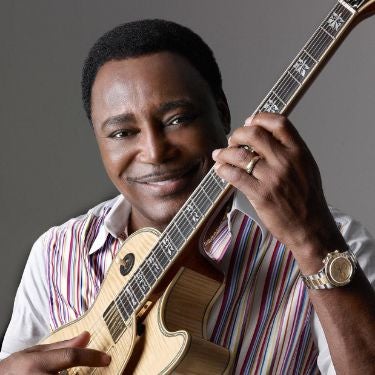
George Benson was born on March 22, 1943, in Pittsburgh, Pennsylvania. He is perhaps one of the greatest jazz guitarists of all time. After beginning his recording career at an early age, Benson played with a number of renowned jazz artists during the 1960s, including Jack McDuff and Miles Davis. His breakthrough success came in the 1970s with his 1976 release Breezin', which included the title track and "This Masquerade." Other hit albums followed, including Give Me the Night in 1980, and a hit single, "Turn Your Love Around" in 1981. He has recorded several gold and platinum albums and has won numerous awards, including eight Grammies. Benson has been one of the busiest entertainers in the business, continuing to record and perform throughout the 1980s, 1990s and 2000s. Known mostly as a jazz guitarist, Benson is also a pop, R&B, and scat singer, and songwriter.
Benson came back in 1980 with another hit album, Give Me the Night, featuring the hit title track, which peaked at number four on the U.S. pop chart. The Quincy Jones-produced album was a culmination of a string of hit albums in an R&B-flavored pop mode. By this time, Benson's guitar had been relegated to the background, putting his vocals and more commercial formulas at the forefront. This was even more evident in Benson's hit single "Turn Your Love Around," which hit number one on the R&B chart and nearly topped the U.S. pop chart, peaking at number five in 1981. Benson continued to record through the 1980s with only minor pop hits, which included "Lady Love Me (One More Time)" in 1983 and "20/20" in 1984. With his guitar work increasingly becoming non-existent in his recordings, Benson continued to receive criticism for the commercialization of his work. Richard S. Ginell of the All-Music Guide to Jazz wrote about Benson's 1983 album In Your Eyes and observed that, "for jazz fans, Benson's albums at this point become a search for buried treasure, for his guitar time is extremely limited."
The jazz guitar work that made him famous returned in 1989, as Benson reversed his field from pop to jazz with a fine album of standards, Tenderly, with the legendary jazz pianist McCoy Tyner. After going on tour with Tyner's trio that year, Benson recorded another album of jazz standards, Big Boss Band, with Count Basie's Orchestra in 1990. His guitar was now again featured more prominently in the 1990s, along with a noticeable improvement in his pop-flavored work. Benson's return to jazz was a showcase for his versatility as a musician, with his ability to play with a wide variety of arrangements: from small ensembles to big bands, with a string section, with hard bop, and with Latin-inflected selections. The success he achieved in the worlds of jazz and pop helped him manage a balance between the two genres, as he appeared in a variety of concert venues and solidified his popularity through the 1990s.