
TOGETHER(NESS)
When I first moved to Kentucky in August of 2019, I had only been to the Commonwealth one time before. Tyler and I had made the decision just a few months prior to move back to his hometown with the realization that we were completely and utterly burnt out, trying to keep up with a cost of living that was rapidly increasing and assuredly outpacing us. Many of our friends were moving away from Tampa around the same time and we had the inkling of a thought: what if we did too?
Tyler has always waxed so poetically about Kentucky with a sense of pride that I don’t think I have for my home state of Florida. I didn’t quite understand it, but I knew it had to be special. Not only the land, or the food, or the bourbon, but above all: the people.
We decided that for a variety of reasons, it would make the most sense for us to move to his hometown of Mt. Sterling, KY. Perhaps it was a harebrained idea, or perhaps it was the change of pace that we had been searching for.
So there we were in the August heat, driving a moving truck through a city I had never visited, to a house I had never seen, with the blind prayer that it would all work out. Once we turned onto the street, many people gave us nods and the proverbial Southern/Midwestern wave. I remarked to Tyler how I thought it was strange that people were waving — did they mistake us for someone else?
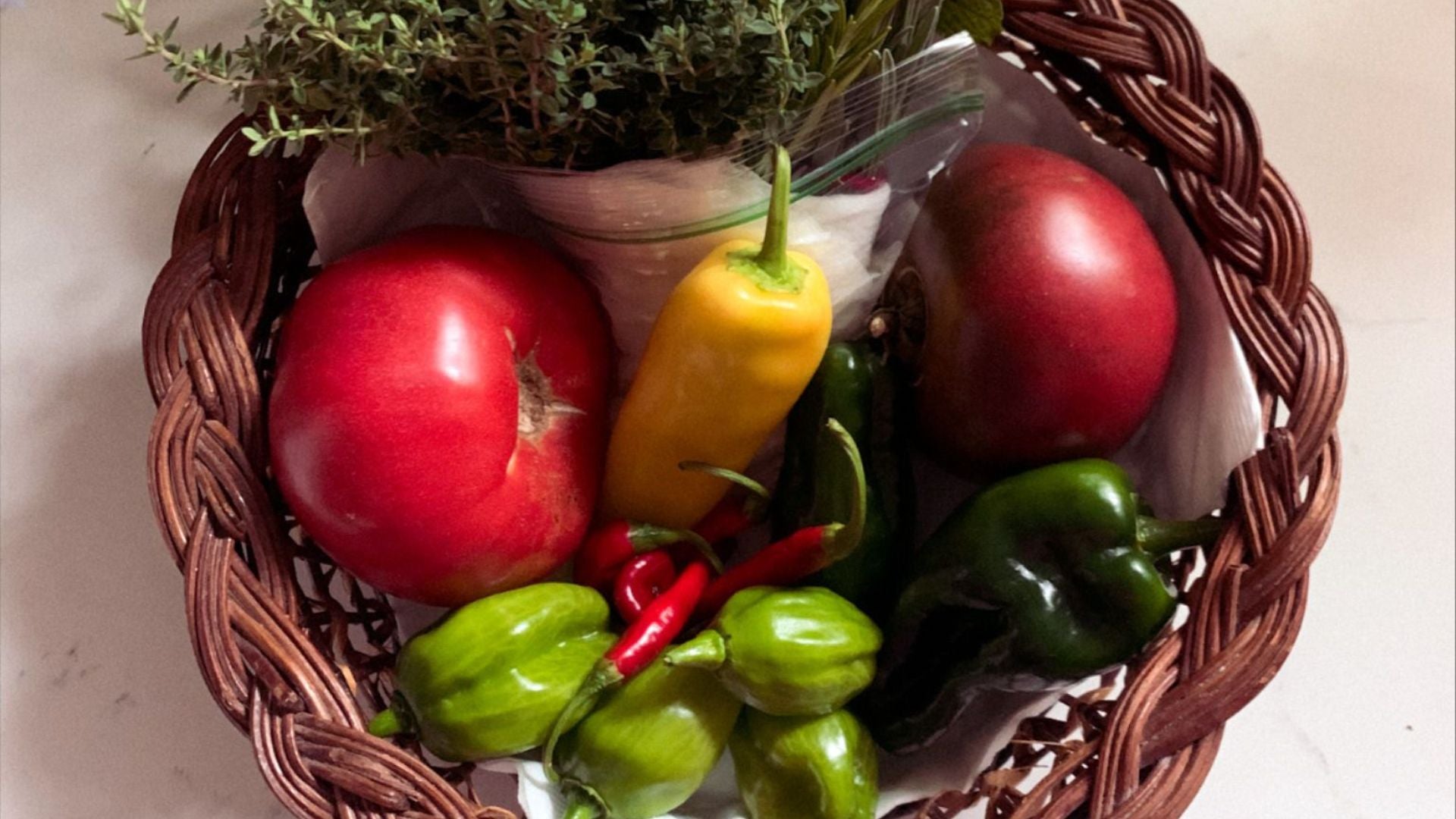
The next day, a mysterious, albeit beautiful basket arrived on our doorstep; it was filled with fresh tomatoes, peppers, and herbs, alongside a note from the house next door introducing themselves.
“Welcome, neighbors!”
I was honestly taken aback by this act of kindness given to total strangers. Growing up in Florida, I had never witnessed this level of generosity to and from people living next door to each other. On one side of my childhood home, there were neighbors we were on a first-name-only basis with. On the other, snowbirds from Canada (an older couple who only lived in Florida half the year). These neighbors were friendly — perhaps giving occasional nods and waves — but my perception of a neighbor was simply… different. Up to this point, it seemed that neighbors largely lived separate lives in their own separate worlds.
After a few months of living in this house in Mt. Sterling, we took a trip to New York City in the fall for a performance of mine. On the flight back Tyler had lamented how it was still hot enough that the grass was growing and that he’d probably have to cut it as soon as we got back.
When we pulled into our driveway, we noticed that the grass was freshly cut.
After some sleuthing, Tyler determined it was again an act of kindness done by our neighbors — different than the ones before. Tyler offered to pay him, but the neighbor refused and said, it wasn’t any trouble; that he did it simply because it needed to be done.
“That’s what neighbors are for, after all.”
It became pretty clear to me that “neighbor” could, and should, mean something more than the people who live on either side of you.
In March of 2020, I was eager for warm weather again in Kentucky. I daydreamed about the veggies and flowers I could grow and lovingly drop on the neighbors’ porches to complement the tomatoes, peppers, and herbs to come. And then, as we all remember: COVID-19 happened.
It felt like nearly every day for the first few weeks, I would get a new email about a performance, commission, or residency that had been canceled. As my opportunities were drying up I felt like I was losing not only work, but things to look forward to and a rhythm to my days. The most exciting (read: terrifying) thing that I was doing at that time was going to Kroger with a KN-95 mask and gloves to buy groceries, then bringing them home to do a ritual of full wiping down before putting them in the fridge or pantry. Despite being an introvert, I found myself quickly restless and longing for social interaction, dining at restaurants, and above all: in-person concerts!
Shortly into the pandemic, Governor Andy Beshear began his daily news updates. I strangely began looking forward to the new ritual of sitting down on the couch at 5 pm to watch these updates and his frequent phrases became mantras stuck in my head:
“We’re all in this together.”
“We will get through this; we will get through this together.”
And never forget: “You can’t be doing that.” (If you know, you know.)
Eventually, Governor Beshear suggested that Kentuckians turn on green porch lights as a symbol of empathy and remembrance for COVID-19 victims and frontline workers. I went to Lowes (again, in mask and gloves) to buy a green light bulb and added another daily ritual: turning on the light at dusk. After Beshear’s daily updates, Tyler and I would flip the switch then stand on the porch for a few minutes to watch the sun set over the horizon while the green light glowed. We would glance down the street and see many of our neighbors doing the same: lots of familiar names and faces, and some whose names we still had yet to get. The nods and waves exchanged from across the way became more precious than ever.
At the time, I didn’t quite have the language for what I was experiencing, but I felt immensely connected to the people next door. Despite doing what was necessary to stay apart we were still, somehow, neighbors. Together.
Six years later, I find myself back in Kentucky — this time in Louisville as a member of the Creator Corps. For this In Harmony Tour, the Louisville Orchestra asked me to write a piece about what Kentucky means to me. I knew immediately where I wanted this piece to “begin”: in my time in Mt. Sterling, where I experienced firsthand that Kentucky holds this beautiful spirit of neighboring — of communal care — of togetherness.
And by “neighboring,” I do mean that as a verb; not the adjective (“neighboring” — adjacent or close by), and not simply the noun (“neighbor”), but the participatory act of being a neighbor: doing more than existing next door.
Writer Christine Hmiel Schudde defines neighboring as the practice of “caring deeply and acting accordingly.” Despite the fact that neighboring, in this sense, might be a new word — a neologism happening in real time — the idea certainly isn’t new.
With Wendell Berry’s recent passing, I’ve found myself revisiting some of his writing, as he also wrote extensively on these concepts and often used different words to encapsulate them, such as belonging and rootedness. Though I couldn’t possibly begin to distill decades of his writing, one particular Berry quote comes to mind. In The Long-Legged House, Berry writes:
“If I belonged in this place it was because I belonged to it.”
To me, the use of the word “to” is everything. To live in a place is simply to exist there, but to belong to a place asks something more of us: to know and care for the place, its people, and to welcome dependence on — and investment in — each other.
I’ve been thinking about these ideas of neighboring and belonging since my last post, when I wrote about terroir: the idea that something can carry the character of the place in which it was made. The more I think about it, the more I’m convinced terroir isn’t just found in things like food, wine, clay, or music. I’m starting to think people have terroir, too.
My piece, Together, is meant to be a celebration of community: of the terroir of Kentucky, and more importantly, Kentuckians. The title nods to the quotes we all know from Governor Beshear, but it is really meant to point to my experience of Kentucky’s inimitable ability to facilitate togetherness.
The piece begins in a crystalline, nearly static sound world (think: shutdown in March 2020). At first, there is very little motion, but over time small gestures begin to emerge, almost imperceptibly, like the first signs of a spring thaw. Gradually, these gestures begin to find one another, passing between instrument families and gathering momentum, eventually building toward something much larger: an ecstatic musical celebration with the entire orchestra playing together.
Within the piece I also explore the dichotomy between two musical interpretations of togetherness: sustained block chords (musicians playing held notes at the same time, just with different pitches), and a technicolor tapestry in which each musician is contributing a small part that creates the whole. One way I do this is through extensive use of hocket — derived from the Old French word hoquet, meaning “hiccup” or “sudden interruption” — in which a melody and/or rhythm is split between two or more voices resulting in an interlocking pattern.
I absolutely LOVE a good hocket, and within Together there are probably thousands of them. To me, a hocket is also the perfect musical microcosm of community, of neighboring, and of working together: no one voice is meant to carry the whole, but the whole is able to carry forth because many voices contribute.
When the musical celebration reaches its peak, the piece doesn’t end there. The piece carries the momentum forward for an afterglow (second party!) suggesting that the vitality of community sustains us long after the moment of gathering has passed.
After all, togetherness isn’t a checkpoint to arrive at, but a practice that we continually renew through neighboring every day: sometimes through simple gifts, small gestures, and shared rituals, but always through a daily devotion to caring deeply and acting accordingly.
That, to me, is what it means to be a neighbor, and to live together.